

One Table, Two Rule Sets
September 24, 2026 / in Data Quality, Configuration / by Data ControllerOne Table, Two Rule Sets
Most Data Controller sites settle into an obvious mapping: one table, one edit screen, one set of validation rules. But that is not always what the business wants. A table of orders might be edited from a finance report that only tolerates small adjustments, and from an operations report where much larger ones are routine. Same table, same columns, same approvers - different rules.
Data Controller's validation rules are configured per table, so this takes a little thought. There are two ways to do it: the one we recommend, and the one to reach for when the first is not available.
Why one table is one rule set
Two configuration tables decide this.
MPE_TABLES is the list of editable tables, and its primary key is (tx_from, libref, dsn). One physical table is one editable table.
MPE_VALIDATIONS holds the rules, and its primary key is (tx_from, base_lib, base_ds, base_col, rule_type). Rules hang off a physical libref.dataset. There is no per-menu or per-report scoping anywhere in the schema, and the editor is handed exactly the rules whose base_lib and base_ds match the table being opened.
So two rule sets on one table need two distinct libref.dataset identities. The question is how to get them without copying the data.
Option 1 (recommended): two librefs over the same data
A libref is just a name pointing at a location. Nothing stops you assigning two of them to the same place, and Data Controller will treat the two as separate tables:
libname ORDERS_EU '/data/orders';
libname ORDERS_US '/data/orders';
ORDERS_EU.ORDERS and ORDERS_US.ORDERS are now the same physical file, but they are different rows in MPE_TABLES and can therefore carry different rows in MPE_VALIDATIONS. Register both, give each its own rules, and point each report at its own editor URL - #/editor/ORDERS_EU.ORDERS and #/editor/ORDERS_US.ORDERS.
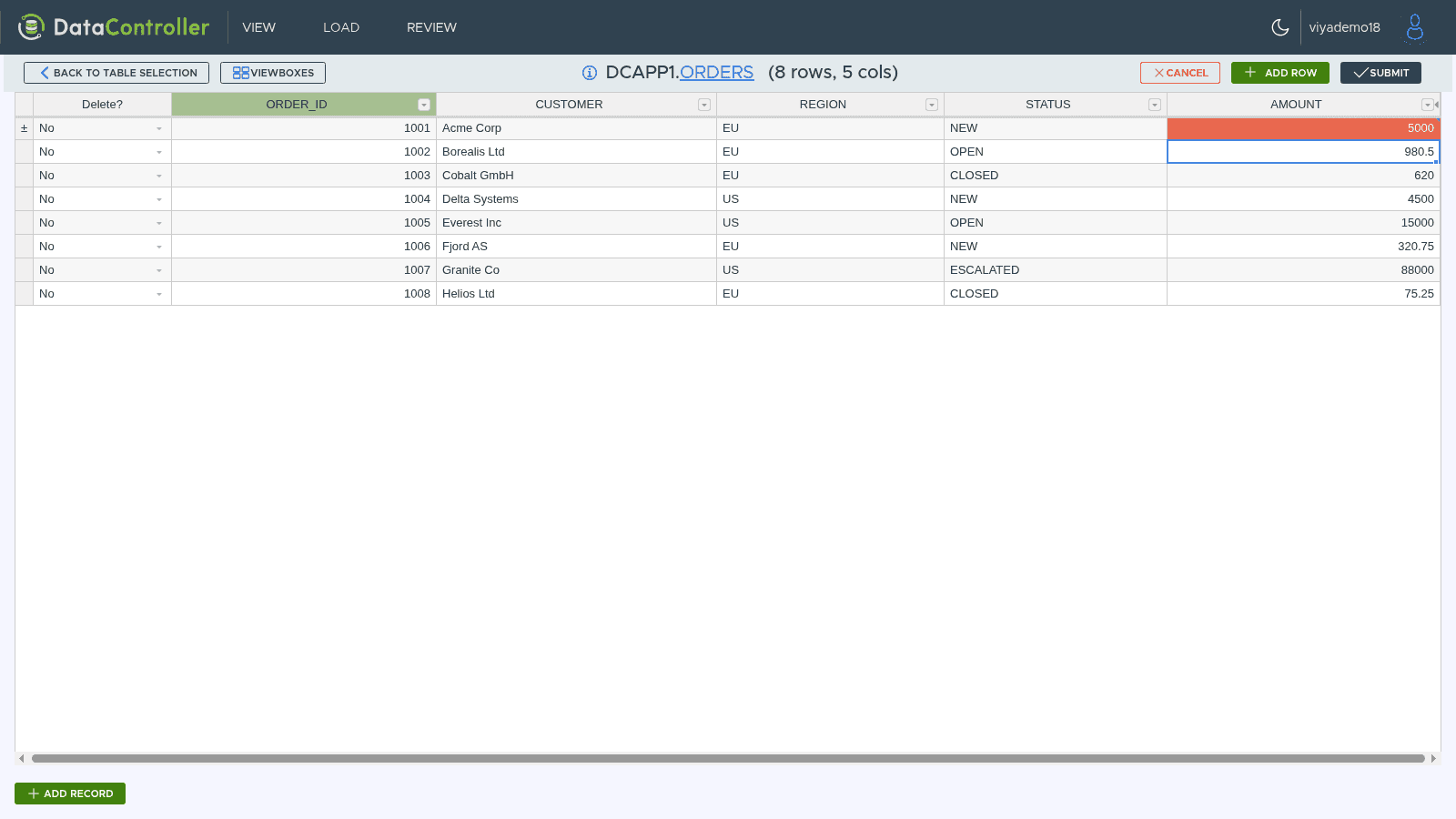
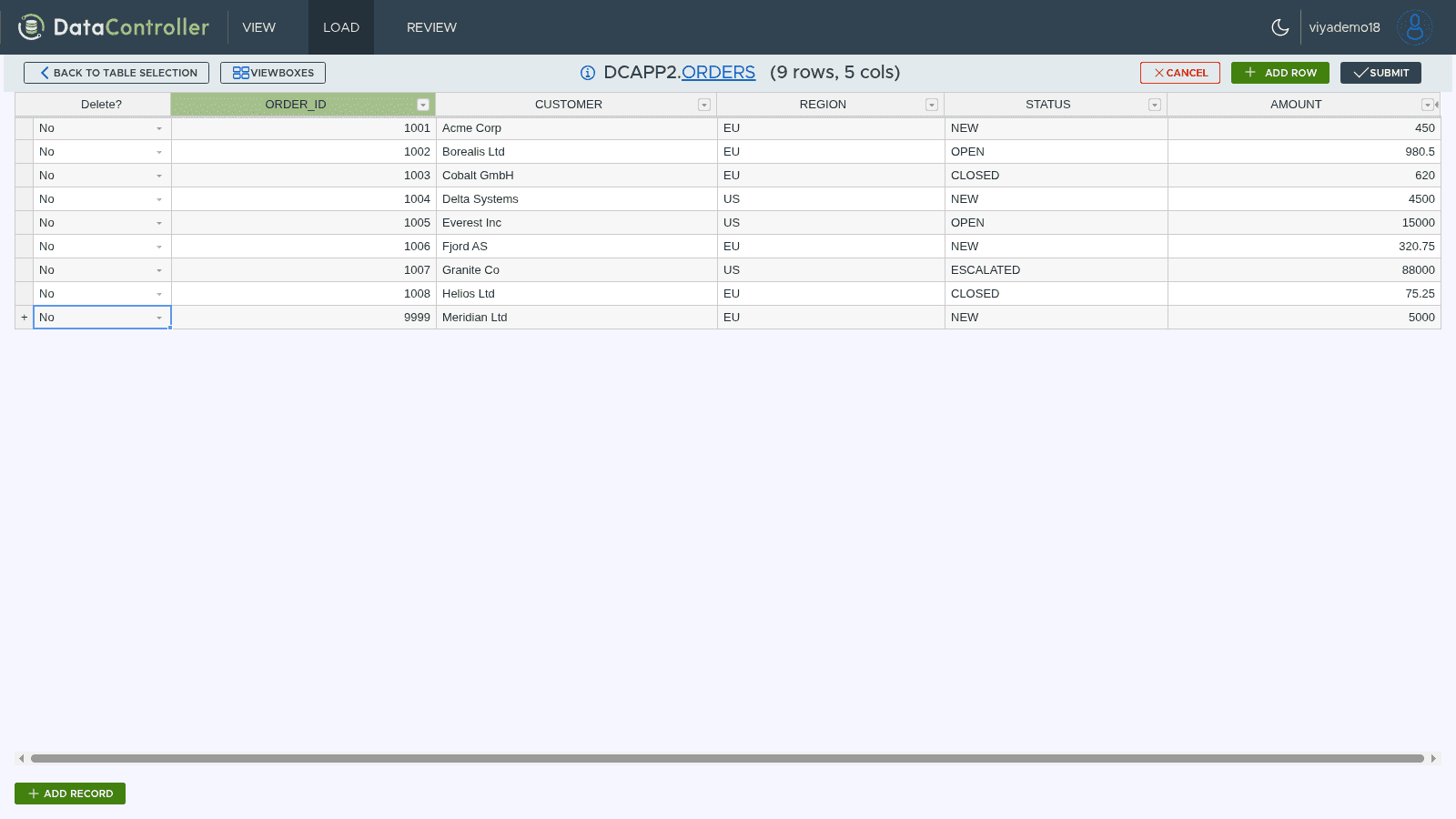
Everything else works exactly as it always did. Filtering, search, the row cap, the approval diff and the audit trail all operate on the table as normal, because as far as Data Controller is concerned these are ordinary tables. The only difference is that the two names resolve to the same file, so an approval in either report updates the same data - and that one difference has a consequence for concurrency, which is covered below.
There is no copy to keep in sync, no hook to write and nothing to maintain. That is why it is the option we recommend.
Things worth knowing
- Where the librefs are defined depends on your platform. On Viya, in the compute context's
autoexec.sas(or[DC Drive Path]/services/settings.sas); on SAS 9, as metadata libraries or in the Data Controller Settings stored process; on SASjs Server, inservices/public/settings.sas. The one requirement is that each library has a unique libref. mp_lockanytablekeys onlibref.dataset, so the two menus do not serialise against each other. That has consequences beyond a collision - see The concurrency caveat below.- The audit trail and approval queue record which libref a change came through, so
ORDERS_EU.ORDERSandORDERS_US.ORDERSstay distinguishable in history. For most people that is a feature - you can see which report a change originated from.
The concurrency caveat
Data Controller serialises its writes with mp_lockanytable, and the control table it uses, MPE_LOCKANYTABLE, has a primary key of (lock_lib, lock_ds). That is the registration, not the physical file. At approve time, postdata takes the lock on the base table named in the submit record, and the same service runs its "has this table been updated since the diff screen was shown" check against MPE_DATALOADS, keyed on that same libref and dsn.
Two librefs over one location are two different (libref, dsn) pairs, so:
- two approvals arriving through different reports take two different locks, and neither one blocks the other;
- a load through one report writes its
MPE_DATALOADSentry against its own name, so the other report's staleness check does not see it either.
So two people editing the same rows through different reports can both be approved, and the second write wins, silently. The lock is advisory to begin with - mp_lockanytable is, in its own words, "only useful if every update uses the macro" - so this is not a new class of risk, but registering one file twice is a new way to fall into it.
The hook route does not have this problem. Both mirrors route their submit to the same base table, so every approval locks, loads and logs against one identity.
If you do use two librefs, and concurrency matters to you, the cleanest fix is to keep the two registrations for the edit screen and give each one a POST_EDIT_HOOK that re-points the changeset at a single canonical registration - then every approval is keyed on the same table regardless of which report raised it. Register that canonical name as well. The alternative, an explicit shared lock taken in PRE_APPROVE_HOOK and released in POST_APPROVE_HOOK, works too, but a failed run leaves the sentinel locked and MPE_LOCKANYTABLE is then a table you have to unpick by hand.
Option 2: an empty mirror and a pair of hook scripts
Sometimes two librefs over one location are not available: a database library where the platform will not let you define the same object twice, or a site where adding a library definition is a change nobody wants to make. Then you can reach the same result with a mirror table and two hook scripts.
The idea is that the thing Data Controller edits is not the real table at all, but an empty table of the same shape, with hooks moving data in and out of it:
- a
PRE_EDIT_HOOKfills the editor with the live rows of the real table, so the mirror never has to hold a copy - a
POST_EDIT_HOOKre-points the submitted changeset at the real table, so the approval is raised against the real table and the load writes there
The mirror exists purely to carry the rule set, and never stores any data.
The pre-edit hook
PRE_EDIT_HOOK runs inside the getdata service, after the user's filter has been applied and the rows sorted, with the data in work.OUT. It may replace that dataset, which is all this needs:
data work.out;
  set ORDERS.ORDERS;
run;
The registered table is ORDERS.MIRROR, which is empty - so without the hook the editor would show nothing at all. With it, the grid shows the live rows:
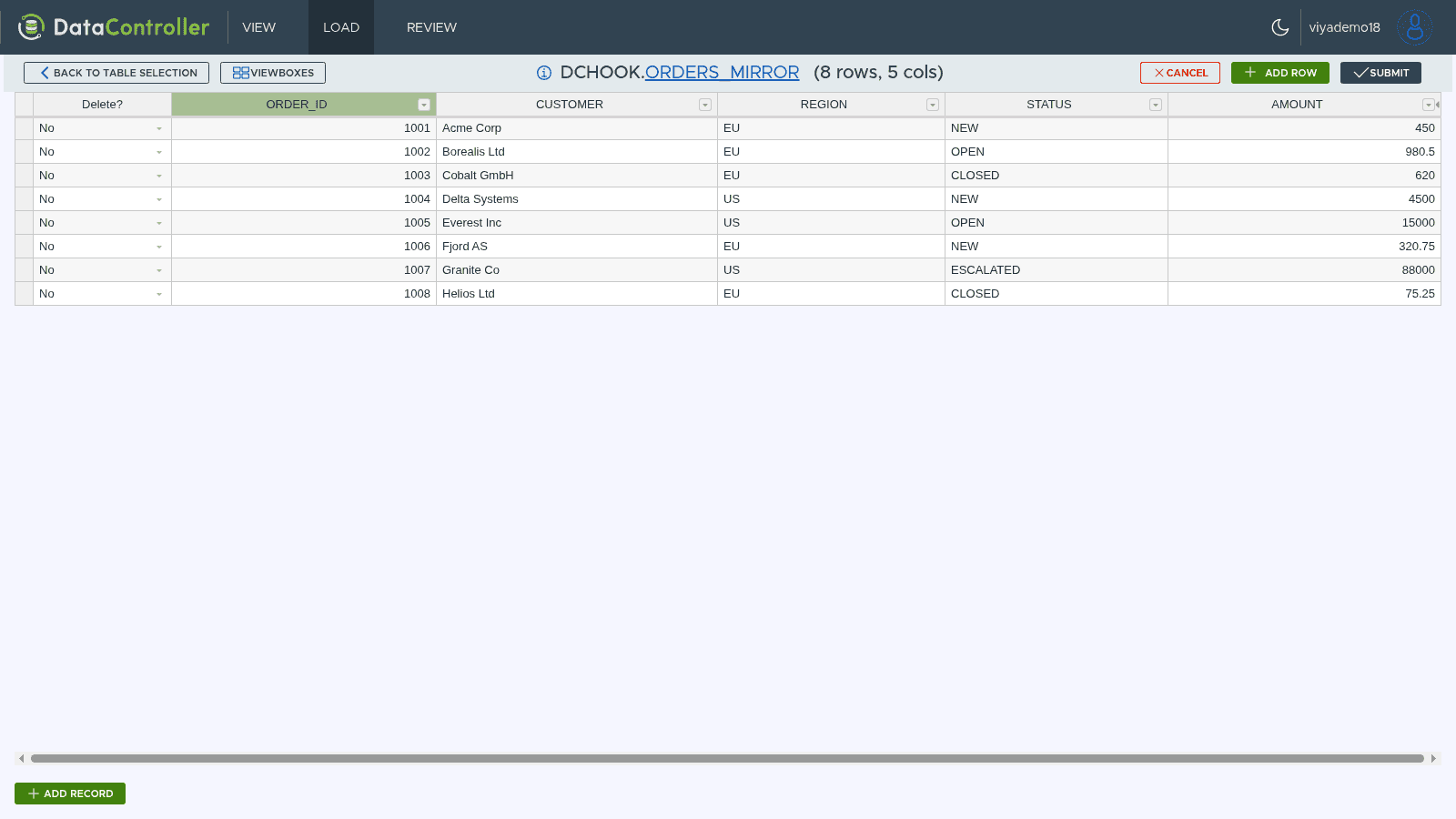
Note the title bar: the mirror really is empty. Everything on screen came from the hook, and the grid is validated against the mirror's own rules rather than the real table's.
The post-edit hook
This is the part that surprises people. POST_EDIT_HOOK runs inside the mpe_loader macro at submit time, on the staged rows, before the submit record is written. It cannot choose the target table directly - but at that point LIBREF and DS are still ordinary macro variables, and the submit record is built from them. Reassigning them re-points the whole changeset:
data _null_;
  call symputx('libref','ORDERS');
  call symputx('ds','ORDERS');
run;
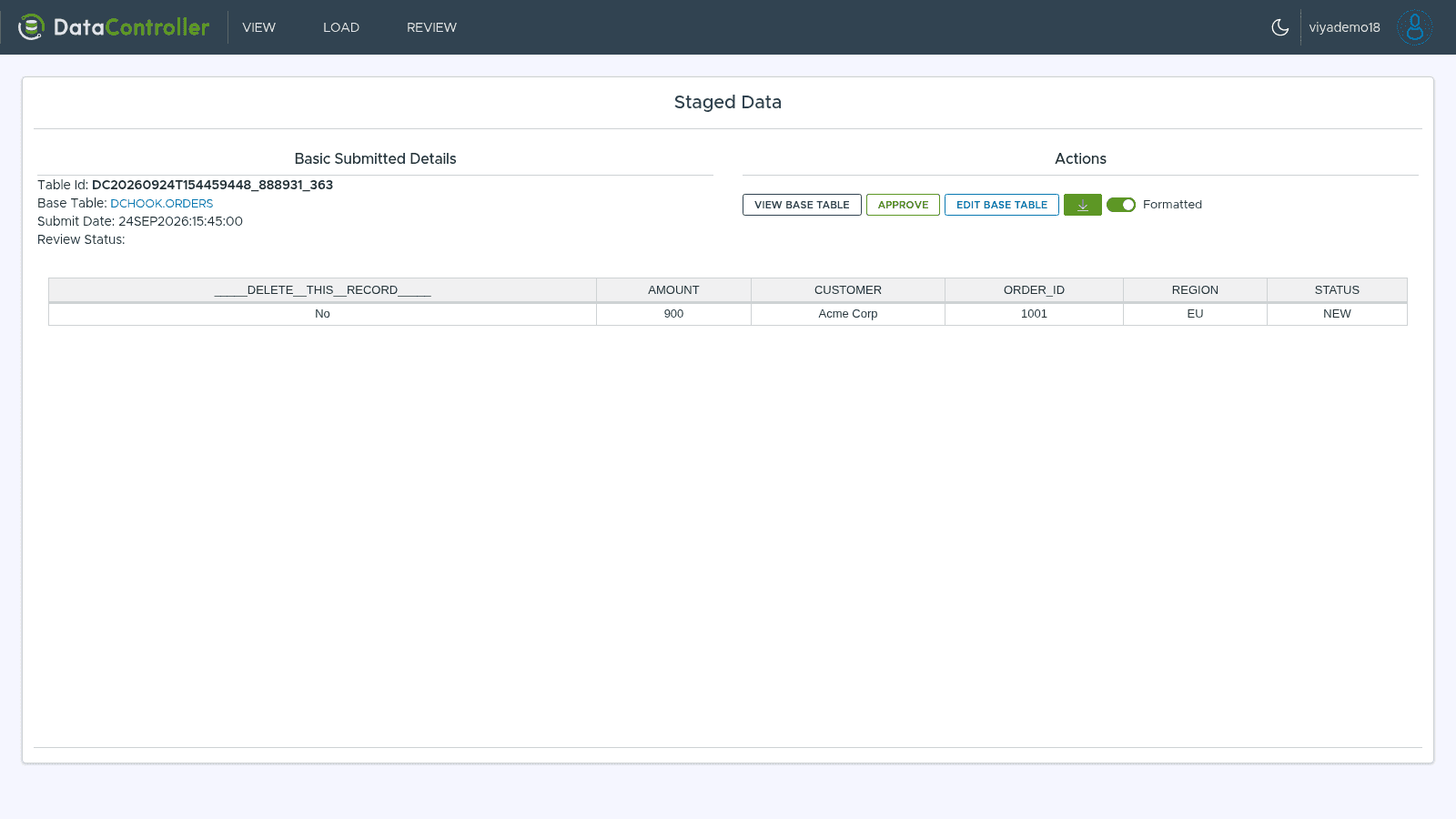
From that moment the changeset is an approval against ORDERS.ORDERS. The approver sees a diff against the real table, the load writes to the real table, and the mirror is never touched.
The detail that will bite you
Use call symputx, not %let. LIBREF and DS are not declared %local in mpe_loader, and the hook is included into that scope - so call symputx finds the existing variable and updates it, while a %let creates a new variable in the hook's own scope and is silently discarded. The hook runs, the log looks clean, and the changeset goes to the mirror anyway.
Other things to watch
- Concurrency behaves correctly here. Both mirrors route their submit to the same base table, so every approval locks, loads and logs against one identity - unlike the two-libref route above.
- The filter has already been applied to the empty mirror by the time the pre-edit hook runs, so a hook that reads the real table ignores the user's filter unless it re-applies it (
where %inc filtref). On a small table you will not notice; on a large one theDC_MAXOBS_WEBEDITcap will stop the edit screen with "Table is too big". - The hook's output must have the same columns the editor expects - the real table, minus any transaction or processing columns that Data Controller drops on load.
- The real table must itself be registered in
MPE_TABLES. The approval screen resolves the table's audit settings from that row, so a changeset routed to a table with no registration cannot be reviewed - the submit is refused up front, naming the table. - The mirror's
MPE_TABLESrow is read for the edit screen and the real table's for the load, so keep theirbuskey,loadtypeand temporal column settings identical. - At approval time the access checks run against the real table, so editors need
EDITon the mirror while approvers needEDITandAPPROVEon the real table.
Which should you use?
If you can define two librefs over the same data, do that. It is configuration only, it leaves every other behaviour of the editor untouched, and there is nothing to maintain.
Reach for the hook scripts when the platform will not let you duplicate the library definition, or when you specifically want the rule set to be a property of the application rather than of the data.
Data Controller
Data Controller is the product of a UK company with a singular focus on SAS Web Apps.
Source Code
Data Controller source is on our self-hosted Gitea Repository; the underlying SASjs framework is on GitHub.